
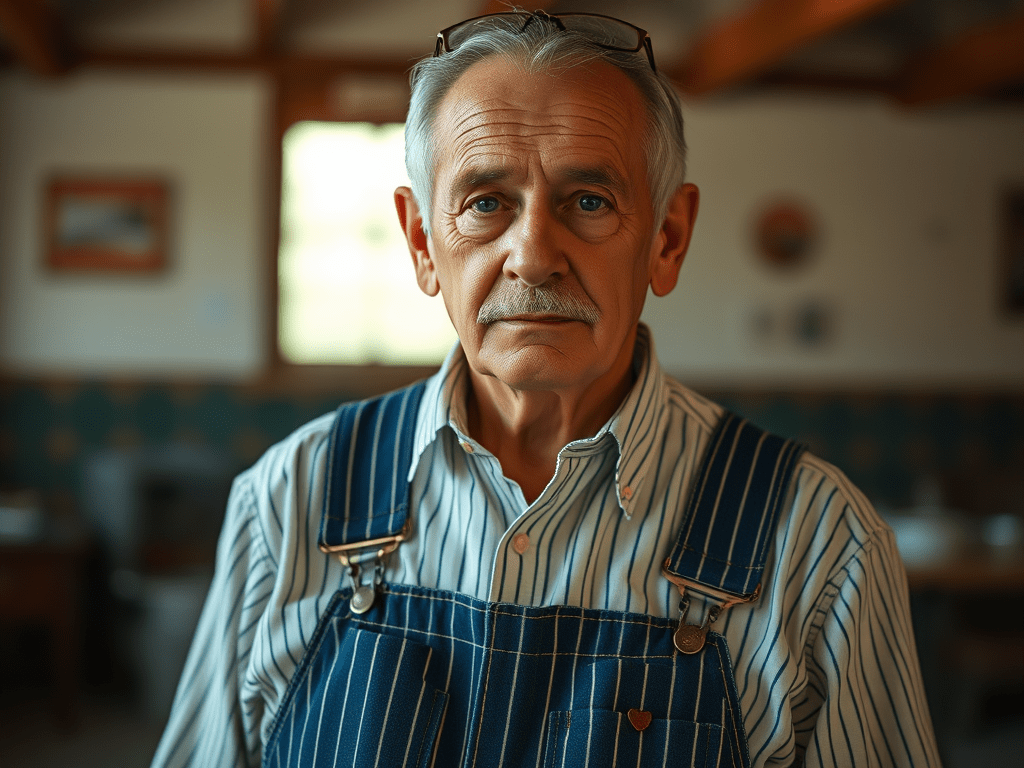

He was an older deacon in our little Baptist church, a retired guy who preferred bib overalls to three-piece suits. Brother Orville had soul-searching eyes, and a calm, yet inquisitive, demeanor. But the most peculiar thing about him is that he volunteered to work with our church youth group—even though he was five or six decades older than any of us. Most people who were about my grandparent’s age thought teenagers were obnoxious know-it-alls. If Orville felt that way, he never let on.
I can still see him standing in front of our Sunday School class, wearing his striped overalls, over a long-sleeved dress shirt, with black shiny wingtip shoes, polished to perfection. He’s holding a ceramic bank, asking us to give our pocket change for foreign missions. As I recall, few gave—at first—but Orville was undeterred. Week after week he stood before us, politely asking us to think about something or someone beyond ourselves. It worked! I brought some change from my car and listened to the clunk, clunk as it dropped to the bottom of the bank. He gave a thin smile, that seemed to say he was proud of me.
The youth group loved asking our much older friend questions, hoping we could stump the grandpa who dared to walk among us. But he never seemed put off by our egocentric “What ifs?” One Sunday, as we studied the creation account, in Genesis, I probed him: “How can something come from nothing?” “That’s exactly how it happened,” he answered with a smile, his wiser eyes diverting mine. I dared not ask him anything else.
Sometime in the early 1980’s when I was about 15, our silver-haired friend was diagnosed with cancer. I don’t remember what kind, but it progressed to the point where he wasn’t strong enough to walk from his back door to Sunday School—he and his wife lived right behind the church. I remember one day when the pastor’s son and I went over to mow Orville’s yard, he showed us how to pour gasoline out of a metal can—without using a funnel! With him there was always a lesson.
Orville’s cancer continued to spread. Soon, he was bedridden. I’d never talked to a dying person before, what would I say? But our pastor encouraged me to go. So, I did.
I stood by the bed. For once, he wasn’t wearing overalls, but pajamas. Brother Orville was so weak he could only whisper. Yet he did most the of the talking. It’s forty years later, and I can’t remember what he said, but they were the last words between us.
After his memorial service, they rolled the casket to the back of the church. My pastor asked me to stand with him, next to Orville. “I know he meant a lot to you, David.”
People who’d known and loved him for years filed past, and some of them consoled me. They knew he was my special friend, and I was his.
In the end, not remembering his final words to me doesn’t matter. Not so much. It was who Orville was—his consistent Christian example–that made the biggest impression.
No written word, no spoken plea, can teach our youth what they should be. Nor all the books on all the shelves. It’s what the teachers are themselves.
Anonymous, quoted by John Wooden
One generation will commend Your works to another, and shall declare your mighty acts.
Psalm 145:4 (ESV)
Thank you for reading. 🙏❤️ prayers and love.


 Davids Daily Dose
Leave a comment